

Keywords: Wastewater decolorizing agent, sewage decolorizing agent, decolorizing agent manufacturer
In the field of industrial wastewater treatment, wastewater decolorizing agents were once considered a “cure-all”—just as the older generation believed that Isatis root could cure all diseases, early decolorizing agents were also highly anticipated. However, with the surge of technological advancements, this “cure-all” fantasy gradually shattered, replaced by precise and efficient targeted agents. Behind this lies a fascinating story of cognitive upgrading, technological iteration, and industrial transformation.
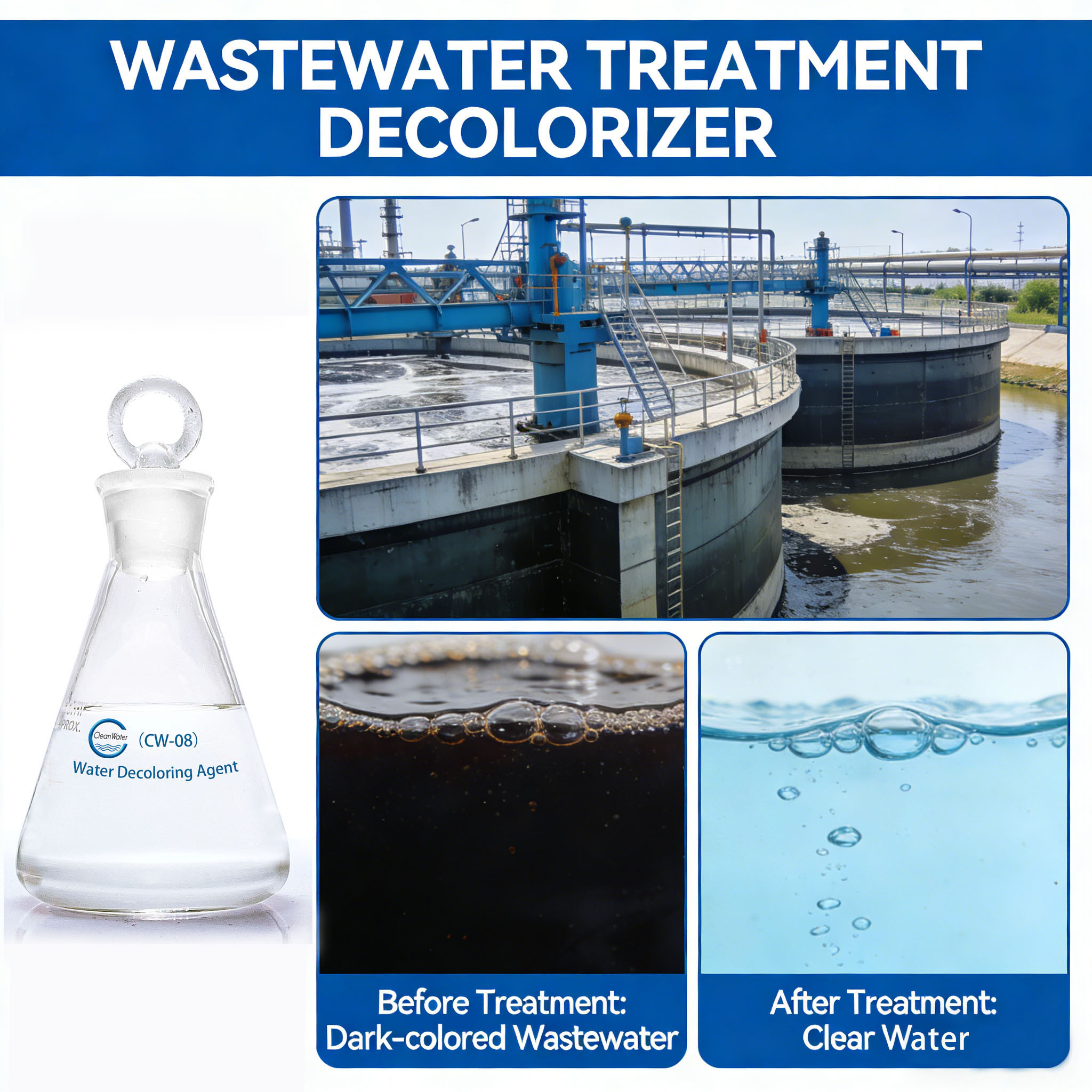
1. The Limitations of the Era of a Cure-all: The “Side Effects” of the Industrial Revolution
At the end of the 19th century, when a textile mill in Manchester discharged the first stream of dyeing and finishing wastewater into a river, humanity’s struggle against colored wastewater began. At that time, wastewater decolorizing agents were like a “cure-all,” with inorganic agents such as lime and ferrous sulfate widely used, achieving initial separation through simple sedimentation. However, this “purification through sedimentation” method is inefficient, like using a large net to catch small fish, and is ill-suited to the increasingly complex industrial wastewater.
With industrial development, wastewater composition has become increasingly complex and diverse. Wastewater from industries such as dyeing, coking, and aquaculture varies greatly in color and COD content. Traditional wastewater decolorizing agents often encounter problems such as loose flocs and difficulty in sedimentation during treatment. This is like trying to open all locks with the same key; the result is often that “the door won’t open, and the key breaks.”
2. A Technologically Driven Turning Point: From “Fuzzy” to “Precise”
In the late 20th century, environmental awareness awakened, and industries began to reflect on the drawbacks of the universal model. Scientists realized that the composition and pollution characteristics of different industrial wastewaters vary significantly, requiring wastewater decolorizing agents to possess targeted technological solutions.
The emergence of cationic decolorization technology marked this turning point. This type of wastewater decolorizing agent achieves rapid decolorization through a neutralization reaction between positively charged groups in its molecular structure and negatively charged chromogenic groups in the wastewater. Just as a magnet attracts iron filings, this targeted action significantly improves treatment efficiency.
An even more revolutionary change is occurring in the era of intelligent technology. The combination of AI algorithms and online monitoring equipment allows for dynamic adjustment of wastewater decolorizing agent dosage, automatically optimizing the ratio based on real-time wastewater quality parameters. This is like equipping the wastewater treatment system with an “intelligent brain,” capable of “thinking” and making optimal decisions.
3. The Arrival of the Customization Era: From “Uniform” to “Exclusive”
Today, professional customization has become a crucial development direction for the wastewater decolorizing agent industry. Companies are developing specialized wastewater decolorizing agent products adapted to different wastewater types based on extensive experimental data and engineering cases. For example, decolorizing agents for dyeing and printing wastewater differ significantly in composition and function from those for coking wastewater.
This transformation brings multiple benefits: significantly improved treatment efficiency, significantly reduced operating costs, and the possibility of wastewater reuse. More importantly, it has driven the industry’s transformation from “end-of-pipe treatment” to a “source revolution.” Cutting-edge explorations such as gene-edited color-producing microorganisms and electrocatalytic decomposition technology are redefining the future of wastewater treatment.
From a “panacea” to “personalized solutions,” the evolution of wastewater decolorizing agents is a history of technology-driven and demand-led transformation. It tells us that there are no “one-size-fits-all” solutions to complex problems; only through continuous innovation and precise measures can true sustainable development be achieved. In the future, with continuous technological advancements, wastewater treatment will become more intelligent and efficient, protecting humanity’s green mountains and clear waters.
Post time: Jan-22-2026